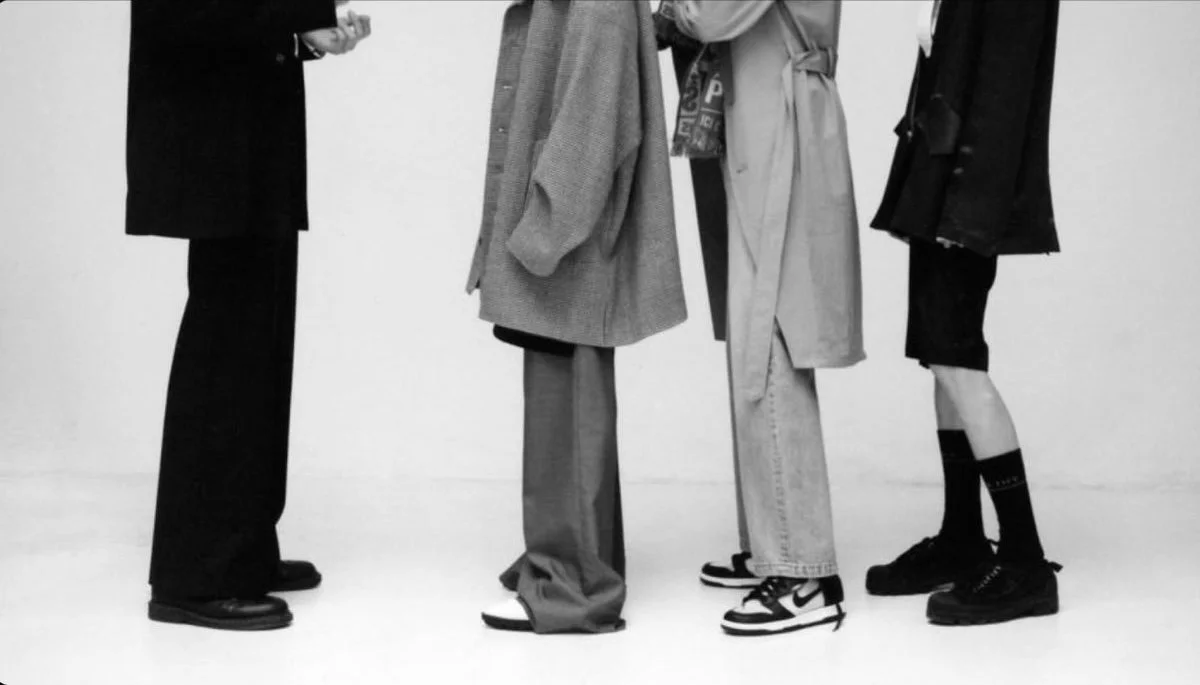
Quiet Luxury & The Aesthetics of Restraint
Embracing minimalism as a form of moral superiority.
By Anna Beth Mauldin
November 17, 2025, 3:18 PM
Fashion rarely abandons spectacle without reason. In recent seasons, its retreat into restraint—neutral palettes, discreet tailoring, garments that resist immediate recognition—has been framed as a return to “timelessness.” But quiet luxury is less a revival of classic dress than a recalibration of visibility. It speaks in codes rather than declarations, favoring understatements not as an absence of expression, but as proof of assurance.
This aesthetic has emerged at a moment when visibility itself has become exhausting. In an economy of constant self-presentation, restraint offers a counter-language. To dress quietly is to signal composure, to suggest one does not need to explain oneself. The lack of logos, the studied simplicity, and the careful neutrality all imply a relationship to wealth that feels inherited rather than acquired.
Historically, fashion’s turn toward restraint has often coincided with periods of economic or cultural instability. Following moments of excess—whether the conspicuous consumption of the late twentieth century or the logo-saturated years of early social media—luxury has repeatedly recalibrated toward subtlety.
The appeal of understatement lies not only in its aesthetic appeal but also in its promise of permanence. When uncertainty dominates the cultural mood, fashion seeks to reassure rather than provoke.
Quiet luxury draws heavily from old European codes of dress, where discretion functioned as a marker of class. True status, in this logic, did not announce itself; it was assumed to be so. Tailoring was impeccable but unremarkable, fabrics luxurious but subdued.
The absence of overt branding was itself a signal—one that separated those who needed to prove their wealth from those who did not. Contemporary quiet luxury inherits this logic, even as it repackages it for a modern audience.
Yet restraint is not the rejection of consumption—it is its refinement. The elevated basics, the perfectly cut trousers, the neutral knit priced far beyond its simplicity, all participate in the same luxury economy as their logoed predecessors.
What changes is the moral framing. Excess becomes synonymous with vulgarity, while discretion is elevated as taste. Minimalism, in this context, is not merely an aesthetic choice but a value system—one that presents itself as ethical, discerning, and culturally literate.
This moral language is central to quiet luxury’s appeal. To consume quietly is to imply intention rather than impulse, longevity rather than trend-chasing. It suggests a form of responsibility that aligns neatly with contemporary anxieties around overconsumption and sustainability. And yet, the ability to invest in “fewer, better things” is itself a privilege. Restraint is easiest to perform when abundance is already assured.
The aesthetic also raises questions about who is permitted to embody timelessness. Neutral palettes, understated tailoring, and minimal silhouettes are often celebrated as universal, but their legibility is far from neutral. Historically, these markers of refinement have aligned most closely with Eurocentric ideals of dress and body. What is framed as classic frequently mirrors what is already familiar to power.
Fashion houses have embraced this language of subtlety with strategic precision. Some runways have shifted away from overt spectacle toward mood-driven presentations that emphasize atmosphere over excess. Logos shrink or disappear altogether, replaced by an emphasis on fabrication, cut, and silhouette. The message is clear: luxury no longer needs to announce itself loudly—it assumes recognition.
At the same time, this turn toward quietness coincides with an industry increasingly driven by visibility metrics. In a digital landscape where virality often determines value, restraint functions as a form of differentiation.
Quiet luxury resists the immediacy of trend cycles, positioning itself as immune to algorithmic volatility. It promises permanence in a system built on acceleration.
The appeal of this promise cannot be separated from the broader cultural moment. Political uncertainty, economic precarity, and social fragmentation have all contributed to a collective desire for stability.
Quiet luxury offers a visual language of control—an aesthetic that suggests calm, order, and continuity even when those qualities feel elusive elsewhere.
Importantly, this restraint is not about disappearing. Quiet luxury is not invisible; it is selective. Its signals are designed to be recognized by those fluent in its codes. The perfectly tailored coat, the unbranded leather bag, the neutral ensemble assembled with precision all communicate status—but only to a narrower audience. Visibility, in this sense, is not eliminated but redirected.
This selectivity is what gives quiet luxury its power. It reinforces boundaries between those who can decode its signals and those who cannot. In doing so, it preserves fashion’s long-standing relationship with exclusivity, even as it adopts the language of accessibility and restraint.
Ultimately, quiet luxury reveals as much about contemporary anxieties as it does about taste. It reflects a desire to withdraw from noise without relinquishing status, to appear conscientious without sacrificing consumption, to be seen without being exposed. Restraint becomes a way of managing visibility in an era where too much of it feels destabilizing.
Fashion, as ever, mirrors the contradictions of its time. Quiet luxury may appear calm on the surface, but beneath its muted palette lies a complex negotiation of power, privilege, and perception. In choosing to speak softly, it reminds us that the most effective signals are often the ones least loudly proclaimed.